
How to Choose a Matcha Supplier: 12 Questions to Ask
How to Choose a Matcha Supplier: 12 Questions to Ask
Switching matcha suppliers costs more than most buyers expect. You retest the spec, rerun your QC, update your labels, and explain the change to customers. That’s why getting the first supplier right matters.
The problem is that most matcha suppliers sound the same on their website. They all claim premium quality, fast shipping, and competitive pricing. The differences only show up when you ask the right questions.
This guide gives you 12 questions to ask before you commit. Use them as a checklist, and you’ll separate the real factories from the resellers.
Why Supplier Selection Matters
Matcha is an agricultural product. It varies by harvest, by region, and by milling method. A supplier who can’t control that variation will send you inconsistent product, and inconsistency kills a brand faster than a bad first batch.
Beyond quality, your supplier affects your margin, your lead time, and your ability to scale. A supplier with a 500 kg MOQ can’t help you launch\60-day lead time can’t help you restock. A supplier who won’t sign an NDA can’t help you develop a proprietary blend.
In short, the supplier decision shapes your product roadmap. Ask the questions before you commit, not after.
The 12 Questions
1. Are you a factory or a trader?
This is the first question, and it determines everything else. A factory controls production, holds inventory, and can customize. A trader buys from a factory, adds a markup, and resells — with less flexibility and less transparency.
Neither is automatically wrong. But you should know which one you’re dealing with, because it affects pricing, lead time, and customization options.
If the answer is “we work with several factories,” ask which one. A good trader will tell you. A bad one will dodge.
2. What certifications do you hold?
Matcha certifications cover food safety, organic status, and quality management. The ones that matter most:
- USDA Organic — required for organic claims in the US
- EU Organic — required for organic claims in the EU
- ISO 22000 — food safety management
- HACCP — hazard analysis and critical control points
- Kosher / Halal — required for certain markets
Ask for the certificate numbers, not just the logos. Then verify them with the issuing body. A supplier who holds real certifications will share the numbers without hesitation.
3. Can you provide a COA for every batch?
A Certificate of Analysis (COA) documents what’s actually in the batch. It should cover:
- Heavy metals (lead, arsenic, cadmium, mercury)
- Pesticide residue
- Microbial panel (total plate count, yeast, mold, E. coli, Salmonella)
- Caffeine and L-theanine content
- Color (L*a*b*), particle size, and moisture
If a supplier can’t provide a COA, that’s a red flag. If they can provide one but only for the first order, that’s another. Every batch should ship with its own COA.
4. What’s your MOQ?
MOQ stands for minimum order quantity. It’s the smallest order a supplier will accept, and it matters most when you’re launching.
A high MOQ (500 kg or more) makes sense for established brands but blocks new ones. A low MOQ (10 kg or less) lets you test the market before committing. Ask for the MOQ per SKU, not per order — a supplier might have a low overall MOQ but a high MOQ per grade.
5. What’s your lead time?
Lead time is the time from order confirmation to shipment. It includes production, filling, labeling, and any custom packaging.
Ask for two numbers: standard lead time and rush lead time. A supplier with a 30-day standard lead time and no rush option will struggle when you need to restock fast. A supplier with a 15-day standard lead time and a 7-day rush option gives you flexibility.
Also ask about lead time during peak season. Chinese New Year and Q4 can add two weeks or more.
6. Can you supply free samples?
A sample is the only way to evaluate matcha before you commit. Ask for a free sample, and expect to cover the courier cost.
A supplier who won’t send a sample isn’t worth your time. A supplier who sends a sample quickly and follows up with a COA is worth a second conversation.
When you receive the sample, test it against your spec. Check color, aroma, texture, solubility, and flavor. Then compare it to a competitor’s sample, side by side.
7. Do you offer private label?
Private label lets you sell matcha under your own brand. If you’re building a brand, this matters.
Ask what the supplier can customize:
- Grade — ceremonial, culinary, latte, or custom
- Packaging — pouches, tins, gift sets, or bulk
- Label — full-color print, Nutrition Facts panel, barcode
- Compliance — FDA registration, EU compliance, organic logo
A supplier who offers private label with a low MOQ is ideal for new brands. A supplier who only sells bulk is better for manufacturers.
8. Can you match my target color and flavor?
Color and flavor consistency are critical for branded products. If your matcha latte looks different every month, customers notice.
Ask the supplier if they can match a target color (measured in L*a*b*) and a target flavor profile. A factory with in-house milling and blending can do this. A trader who resells whatever they buy cannot.
If you’re developing a new product, ask for a bench sample at your target spec before you commit.
9. How do you handle quality issues?
Every supplier has a bad batch eventually. What matters is how they handle it.
Ask:
- What’s your policy on out-of-spec batches?
- Do you replace or refund?
- How fast do you respond to a complaint?
- Do you cover the cost of a rejected shipment?
A supplier who answers these clearly has dealt with quality issues before. A supplier who dodges the question hasn’t thought about it.
10. Do you sign NDAs?
If you’re developing a proprietary blend, you need an NDA. It protects your formula, your packaging design, and your customer list.
Ask if the supplier will sign a mutual NDA. A mutual NDA protects both sides — yours and theirs. A supplier who refuses to sign one isn’t serious about partnership.
11. What are your payment and shipping terms?
Payment and shipping terms affect your cash flow and your landed cost.
Ask:
- Payment terms — 30% deposit / 70% before shipment, or 100% upfront?
- Payment methods — T/T, L/C, PayPal, or other?
- Shipping terms — FOB, CIF, or DDP?
- Shipping methods — air, sea, or express?
A supplier who offers flexible terms is easier to work with. A supplier who demands 100% upfront is riskier, especially on a first order.
12. Can you scale with my growth?
Your supplier should grow with you. If you double your volume next year, can they handle it?
Ask:
- What’s your monthly production capacity?
- Can you reserve capacity for contract customers?
- Do you offer volume pricing tiers?
- Do you have a wholesale program?
A supplier who can scale with you is a long-term partner. A supplier who can’t will force you to switch later, which costs time and money.
Red Flags to Watch For
Some answers should end the conversation. Watch for these:
- “We work with many factories” without naming one — likely a trader with no control over quality
- No COA or a COA that only covers the first order — no batch-level traceability
- MOQ too high for a first order — they don’t want small customers
- Lead time of 45+ days with no rush option — you’ll run out of stock
- Refuses to sign an NDA — not serious about partnership
- Demands 100% upfront on a first order — no confidence in their own product
- Avoids questions about certifications — likely doesn’t hold them
One red flag is a concern. Two is a pattern. Three means walk away.
How We Answer These Questions
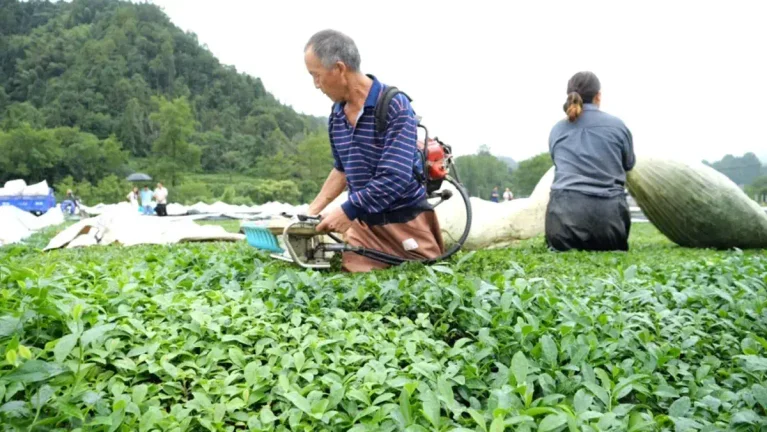
We’re a factory, not a trader. We grow, harvest, and mill matcha in our own certified facility in China.
- Certifications — USDA Organic, EU Organic, ISO 22000, HACCP
- COA — provided with every batch, with 24-month sample retention
- MOQ — 10 kg (22 lb) per SKU for pouches; 500 units for white label
- Lead time — 15–25 days standard; rush options available
- Samples — free; you cover freight
- Private label — custom grade, packaging, and labeling
- Color and flavor matching — in-house milling and blending
- Quality issues — replace or refund on out-of-spec batches
- NDAs — mutual NDAs signed before formula discussions
- Payment terms — flexible; 30% deposit standard
- Shipping — FOB, CIF, or DDP; air, sea, or express
- Capacity — monthly capacity reserved for contract customers
If you’d like to test us against these 12 questions, request a sample and a quote. We’ll answer every one.
Frequently Asked Questions
What’s the most important question to ask a matcha supplier?
“Are you a factory or a trader?” The answer shapes everything else — pricing, lead time, customization, and quality control.
Should I buy from a factory or a trader?
A factory gives you better pricing and more control. A trader can be useful for small orders or hard-to-source grades. Know which one you’re dealing with.
How do I verify a supplier’s certifications?
Ask for the certificate number and verify it with the issuing body. USDA Organic certificates are verifiable through the USDA Organic Integrity Database. EU Organic certificates are verifiable through the issuing control body.
What’s a reasonable MOQ for a first order?
10–25 kg per SKU is reasonable for a first order. Anything above 100 kg is high for a new brand.
What’s a reasonable lead time?
15–30 days standard, plus shipping. Anything above 45 days is slow unless it’s a custom formula.
Do I need an NDA?
If you’re developing a proprietary blend or packaging design, yes. A mutual NDA protects both sides.
What if the supplier won’t send a sample?
Walk away. A supplier who won’t send a sample isn’t serious about your business.
How do I compare samples from two suppliers?
Test them side by side for color, aroma, texture, solubility, and flavor. Then compare the COAs. If one is clearly better, the decision is easy. If they’re close, compare pricing and lead time.
The Bottom Line
Choosing a matcha supplier comes down to transparency and control. A factory that answers these 12 questions clearly will give you consistent quality, predictable lead times, and room to grow. A supplier who dodges them will cost you time and money.
Use these 12 questions as a checklist. Ask them before you commit. Then compare the answers side by side.
If you’d like to see how we answer them, send us a note. We’ll reply within 24 hours.