Matcha Caffeine Content: What Buyers Need to Know
Matcha Caffeine Content: What Buyers Need to Know
If you formulate products with matcha, caffeine content is one of the first numbers you need. It shapes your label, your marketing claims, and your regulatory compliance. Get it wrong, and you either overstate the energy lift or understate the stimulant load.
The challenge is that matcha caffeine content isn’t one fixed number. It shifts by grade, by harvest, by leaf selection, and by how you prepare it. A ceremonial powder and a culinary powder from the same farm can differ by 30 percent or more.
This guide gives you the numbers, the variables, and a practical framework for labeling your product accurately.
The Short Answer
Matcha contains roughly 19 to 44 mg of caffeine per gram of powder. A standard 2 g serving delivers about 38 to 88 mg.
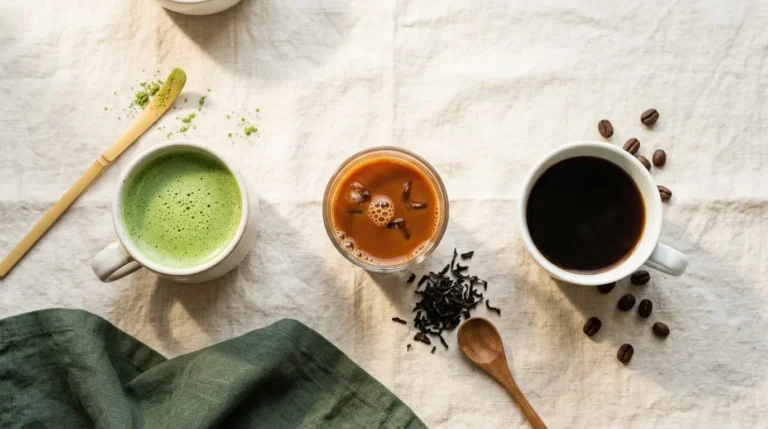
For context, an 8 oz cup of brewed coffee contains about 95 mg. A single shot of espresso contains about 63 mg. A cup of regular green tea contains about 28 mg.
So a 2 g serving of matcha lands between green tea and coffee. That’s your baseline. Everything else — grade, preparation, and product format — moves that number up or down.
How Matcha Caffeine Compares to Coffee
The comparison matters because customers ask about it, and because your label needs to be accurate. Here’s how the numbers stack up.
| Drink | Serving | Caffeine |
|---|---|---|
| Matcha (ceremonial) | 2 g | 38–88 mg |
| Matcha (culinary) | 2 g | 38–70 mg |
| Brewed coffee | 8 oz | ~95 mg |
| Espresso | 1 shot (1 oz) | ~63 mg |
| Green tea | 8 oz | ~28 mg |
| Black tea | 8 oz | ~47 mg |
On paper, matcha and coffee look similar. In practice, they feel different — and that difference comes down to how the caffeine releases.
Why Matcha Caffeine Feels Different
Matcha contains L-theanine, an amino acid that modulates caffeine’s effect. L-theanine promotes calm alertness, and it smooths out the sharp peak and crash that coffee produces.
When you drink coffee, caffeine hits your bloodstream fast. You feel a spike within 15 to 30 minutes, then a crash a few hours later. When you drink matcha, the caffeine releases more gradually. The L-theanine softens the edge, so you get a steadier lift without the jitters.
That’s why matcha marketing often uses the phrase “calm energy.” It isn’t a slogan — it’s a measurable difference in how the body processes the caffeine.
For product developers, this matters. If you position your product as a coffee alternative, the L-theanine content matters as much as the caffeine content. A matcha with high caffeine and low L-theanine will feel more like coffee. A matcha with balanced caffeine and L-theanine will feel smoother.
Caffeine by Grade
Not all matcha carries the same caffeine load. Grade, harvest, and leaf selection all shape the final number.
Ceremonial grade comes from the first harvest. First-flush leaves are younger and more concentrated, which means higher caffeine and higher L-theanine. A 2 g serving typically delivers 60 to 88 mg.
Culinary grade comes from later flushes. Older leaves contain slightly less caffeine, and they also contain more catechins. A 2 g serving typically delivers 38 to 70 mg.
Matcha extract is standardized. Producers concentrate the active compounds, so the caffeine content stays consistent from batch to batch. A 10:1 extract might deliver 80 to 120 mg per serving, depending on the spec.
Decaffeinated matcha goes through a decaffeination process that removes most of the caffeine. A 2 g serving typically delivers less than 10 mg. Note that decaffeination also reduces L-theanine, so the “calm energy” effect is weaker.
If you formulate a product with a specific caffeine target, ask your supplier for the caffeine content per gram. A factory that tests every batch can give you the exact number. A trader who resells whatever they buy cannot.
What This Means for Your Product Label
Caffeine labeling rules vary by market. In the US, the FDA requires caffeine content on the Nutrition Facts panel if it’s added, but naturally occurring caffeine in tea is often exempt. caffeine content above 150 mg/L must carry a warning label. In Canada, caffeine content must be declared on the label.
Here’s what you need to do:
Test every batch. Caffeine content varies by harvest and grade. A single test on one batch doesn’t cover the rest.
Calculate per serving. Caffeine per gram is useful for sourcing, but your label needs caffeine per serving. Multiply the per-gram number by your serving size.
Add a warning if required. If your product exceeds the local threshold, add the required warning label.
Check your claims. If you market your product as “low caffeine” or “high caffeine,” make sure the number supports the claim.
A supplier who provides a COA with caffeine content per batch makes this process much easier. If your supplier doesn’t test caffeine, ask them to start.
Formulating with Caffeine in Mind
If you develop a matcha product, caffeine content isn’t just a label requirement — it’s a formulation variable.
For a coffee alternative, target caffeine in the 60 to 90 mg range per serving, balanced with L-theanine at a 1:2 ratio. That delivers a steady lift without the crash.
For a bedtime or relaxation product, choose decaffeinated matcha or a low-caffeine grade. Pair it with L-theanine or other calming compounds.
For a pre-workout product, target higher caffeine — 100 mg or more — with a lower L-theanine ratio to keep the energy sharp.
For a daily wellness product, target moderate caffeine — 40 to 60 mg — with balanced L-theanine. That delivers a gentle lift without overstimulation.
Each positioning requires a different spec. A factory that can adjust caffeine and L-theanine content to your target gives you more control over the final product.
How to Verify Caffeine Content in a Matcha Supply
If you source matcha, here’s how to verify caffeine content before you commit:
- Ask for the COA. A batch-level Certificate of Analysis should include caffeine content by HPLC.
- Request a sample. Test the sample yourself, or send it to a third-party lab.
- Compare across batches. Ask for COAs from two or three batches to see how much the caffeine content varies.
- Check the grade. Ceremonial and culinary grades have different caffeine profiles. Make sure the COA matches the grade you’re buying.
- Ask about the decaffeination method. If you buy decaf, ask whether the producer used CO2, solvent, or water processing. Each method affects the final L-theanine content.
- Confirm the serving size. Caffeine per gram is useful, but you need caffeine per serving for your label.
A supplier who answers these questions clearly is worth a second conversation. One who can’t probably doesn’t test their product.
Frequently Asked Questions
How much caffeine is in a cup of matcha?
A standard 2 g serving delivers about 38 to 88 mg of caffeine, depending on the grade and the harvest. That’s roughly half the caffeine of an 8 oz cup of coffee.
Does matcha have more caffeine than coffee?
No. Per serving, matcha contains less caffeine than coffee. An 8 oz coffee has about 95 mg, while a 2 g matcha serving has 38 to 88 mg.
Does matcha have less caffeine than green tea?
No. Gram for gram, matcha contains more caffeine than regular green tea because you consume the whole leaf. A 2 g matcha serving has more caffeine than an 8 oz cup of steeped green tea.
Why does matcha feel different from coffee?
Matcha contains L-theanine, which modulates caffeine’s effect. The result is a steadier lift with less jitter and no crash.
Is decaf matcha really caffeine-free?
No. Decaffeinated matcha contains a small amount of caffeine — typically less than 10 mg per 2 g serving. Decaffeination also reduces L-theanine content.
How do I calculate caffeine per serving for my label?
Multiply the caffeine content per gram by your serving size in grams. For example, 25 mg/g × 2 g = 50 mg per serving.
Can I reduce the caffeine content in my product?
Yes. You can use decaffeinated matcha, blend matcha with other ingredients, or reduce the matcha serving size. Each option affects the flavor and the functional benefit.
Does the milling method affect caffeine content?
No. Caffeine content comes from the leaf and the harvest, not the milling method. However, stone-grinding preserves more L-theanine, which affects how the caffeine feels.
Do you test caffeine content in every batch?
Yes. We test caffeine content by HPLC for every batch, and we include the result in the COA.
The Bottom Line
Matcha caffeine content ranges from 19 to 44 mg per gram, depending on the grade and the harvest. A standard 2 g serving delivers 38 to 88 mg — less than coffee, more than regular green tea.
What makes matcha different isn’t the caffeine number. It’s the L-theanine, which smooths out the caffeine effect and delivers a steadier lift. If you formulate a product, both numbers matter.
Test every batch, calculate caffeine per serving, and label accurately. A supplier who provides batch-level COAs makes that process straightforward. One who doesn’t makes it a guessing game.
If you’d like a sample with a full COA, including caffeine and L-theanine content, send us a note. We’ll reply within 24 hours.